

Mission Statement:
To endeavor to bring to all residents of the Five States the most current and important news from across the entire Five States region. Never yellow, the Five States Herald vows to serve only the people of the Five States, from New Austin to Lemoyne, free of charge now and forever.
Civics Lesson Turned Upside Down!
By Sofia Kathleen Fairfax – Lead Correspondent
Do you recall being taught how government and law work? Did you enjoy these types of classes as a child? Did you ever ponder how what you’re taught on paper doesn’t always correlate to your lived experiences? Well, some Valentine kids learned that today.
A class was taught the importance of the US Constitution and the concepts of justice and equality as laid out by the founders. The teacher, who has remained anonymous, said the class started off well enough, until one of the girls noted her mom cannot vote. Then another student mentioned his grandfather being a slave, and then an Irish lad mentioned his older brother being paid less. The teacher tried to have satisfying answers, but couldn’t.
It only got worse when a suffragette riding into town fell off her horse and was mocked by local farmers, even throwing mud in her face. The teacher tried to loudly continue the lesson, but gave up when gunfire erupted over a minor bar brawl in the saloon. Sheriff Malloy did little about the fight. The teacher dismissed the students for the day. She didn’t see much point in talking about everyone being equal and the law meant to protect people, when in Valentine, none of that is close to true.

Sandstorm uncovers forgotten graves west of Armadillo
By Jose Chavez
A fierce desert storm rolling across the flats west of Armadillo this week has uncovered what appears to be a long forgotten burial ground buried beneath years of drifting sand and hard wind. Ranch hands traveling the old wagon trail toward Ridgewood Farm first noticed weathered wooden markers jutting crooked from the dunes after the storm passed, along with fragments of coffins exposed by the shifting earth. By nightfall, curious townsfolk and prospectors had gathered at the site carrying lanterns and shovels, uncovering at least seven graves arranged in uneven rows facing east toward the rising sun. Several of the markers bore no names at all, while others had become too worn to read. One elderly resident claimed the graves may belong to laborers and settlers lost during the terrible cholera outbreaks that plagued New Austin years earlier, though others insist the burial site may have belonged to victims of outlaw raids or range disputes now largely forgotten by the territory.
The discovery has stirred old anxieties across Armadillo, where memories of sickness, drought, and violence still cling stubbornly to the dust. Some residents have urged Sheriff Palmer to fence off the area and prevent treasure hunters from disturbing the dead after rumors spread that one grave yielded a silver watch and several gold coins when scavengers began digging recklessly through the night. Others fear the exposed burial ground may deepen Armadillo’s already grim reputation among travelers passing through the desert territory. “This country swallows people whole,” one rancher remarked while surveying the windswept graves. “Sometimes the sand just decides to give ’em back.”

Frozen body recovered from Lake Isabella stirs rumors of hidden fortune
By Delphia Atwood
A fisherman working the brutal northern reaches of Lake Isabella made a grim discovery this week after carving a narrow hole through the lake’s thick frozen surface and spotting what he first believed to be driftwood moving slowly beneath the ice in the dark water. Instead, the object proved to be the frozen body of an unidentified man, rigid as timber and pale from prolonged exposure to the mountain cold. The fisherman, who hauled the corpse ashore alone, described the dead man’s fingers as “locked tight around something like his soul depended on it.” That object, according to the witness, was a weathered scrap of paper bearing what appeared to be a hand-drawn map. Rumors spread quickly among trappers and prospectors camped through the Grizzlies that the map pointed toward some hidden cache buried deep within the snowbound wilderness. No marks of violence were publicly reported on the body, though several mountain men privately speculated the unfortunate soul may have frozen while searching for whatever treasure the map promised.
The fisherman admitted to following the directions himself after removing the paper from the corpse’s grasp, leading him to a concealed chest tucked among rocks and snowdrifts not far from the lake. Yet when questioned by travelers and later by a passing patrol rider, the man insisted the chest contained nothing at all. Witnesses, however, reportedly found his manner uneasy and suspicious, with one trapper claiming the fisherman repeatedly adjusted the weight of his coat as though hiding something beneath it. With no identity established for the dead man only a limited investigation is expected.

Questions gather around Strawberry jail after bounty deaths
By Odell Clifton
Sheriff Hanley’s office of corruption and deadly mishandling of prisoners brought in from the high country. The bounty hunter, a mud-stained rider who declined to provide his full name to the Herald, claimed he delivered six captured outlaws alive and shackled inside his prison wagon after a two day pursuit. “I took six bounties, all caught alive and secured in my wagon,” the hunter told this paper beside the freight station, “but somehow in the transfer to the Strawberry cells, two were killed.” Deputies attached to the sheriff’s office firmly rejected the accusation and insisted the two men were already dead upon arrival, though several townsfolk reportedly heard shouting and violent commotion from the rear holding corridor shortly after the prisoners were unloaded. One stablehand claimed he saw blood being washed from the jail steps before sunrise, though officials refused comment on the matter.
The incident has stirred uneasy talk among trappers, hunters, and hired guns who pass regularly through Strawberry carrying wanted men from the mountains and Cumberland roads. Critics argue the small jailhouse is ill-equipped for large transfers and accuse deputies of rough treatment toward captured prisoners once bounty money has changed hands. Others whisper darker suspicions still, alleging certain outlaws are beaten for information or revenge before reaching a courtroom. Sheriff Hanley has thus far declined calls for any formal inquiry, stating only that “dangerous criminals often expire resisting lawful custody.” For bounty hunters, they are worried that such actions will make their trade less lucrative. “A dead bounty is worth less than a living one,” said another bounty hunter, “this practice saves them money but denies me the fruit of my labor!”
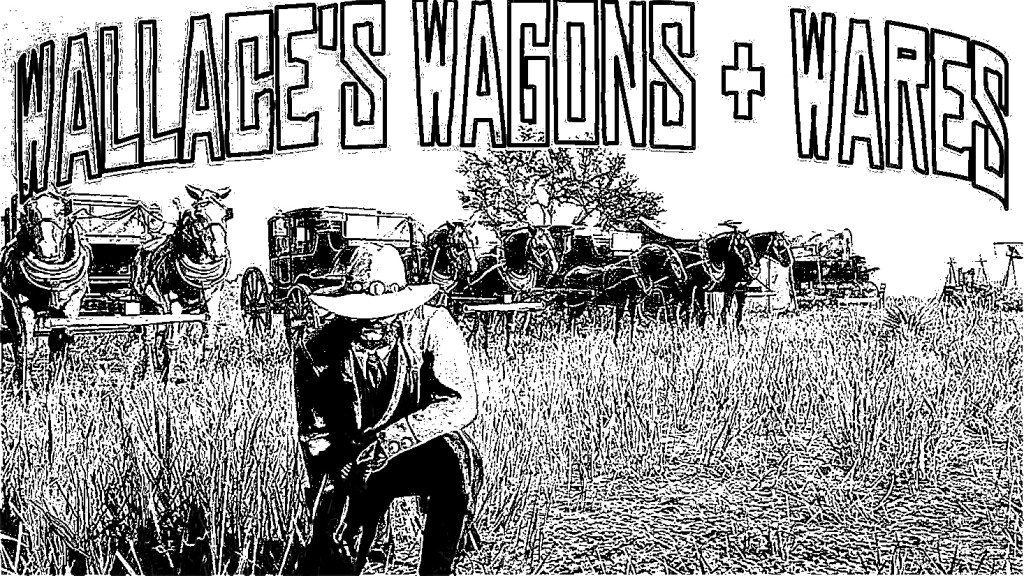

Valentine merchants seek ban on masks inside businesses
By Donna Deshner
Shopkeepers throughout Valentine are pressing Sheriff Curtis Malloy and local deputies to establish a formal prohibition against masks being worn inside stores after a string of unsettling encounters this week involving disguised cowpokes lingering silently among customers. Though no robberies or assaults were reported, merchants described an atmosphere of intimidation as several riders entered general stores, tailor shops, and gun counters with their faces concealed beneath cloth wraps, execution hoods, or painted masks more commonly associated with highwaymen. One clerk claimed a masked customer spent nearly twenty minutes staring at shelves without speaking before abruptly leaving on horseback. Others reported similar incidents involving men silently leaning against counters or watching clerks from shadowed corners. “You spend enough time in this town and you learn trouble usually wears a face covering,” one merchant told the Herald. “A decent man removes his hat indoors and his mask besides.”
Tensions reportedly rose further when several masked patrons attempted to conduct ordinary business while refusing requests to uncover their faces. Most shopkeepers declined service outright, leading to heated exchanges and at least one deputy being summoned to escort a rider from Smithfield’s saloon-side mercantile. Sheriff Malloy has not announced any immediate ordinance, though deputies privately admit the matter has become difficult to ignore as robberies and outlaw violence continue across the Heartlands. Some residents argue such a ban would unfairly target travelers shielding themselves from dust or illness, while others insist the masks serve no purpose beyond intimidation. For now, Valentine merchants say they simply wish to conduct trade without feeling as though every customer might pull a revolver the moment business turns sour.

Strange masked prowler unsettles Saint Denis nights
By Emeline Vickroy
Residents across Saint Denis are trading increasingly peculiar tales concerning a shadowy man said to wander rooftops and alleyways dressed in what witnesses describe as a dark animal costume with pointed ears and a heavy cloak. The figure has reportedly been spotted standing motionless atop factories, churches, and boardinghouses overlooking the city streets long after midnight, often during fog or rain. “Seems a weird way to brood,” remarked one resident outside a café near the Bastille Saloon, “but I suppose he’s an odd duck, as they say.” Though many dismiss the stories as drunken exaggeration born from the city’s late-hour crowds, enough sightings have emerged from separate districts to attract serious attention from nervous shopkeepers and night watchmen alike. Some claim the figure vanishes between buildings without warning, while others insist he travels by grappling rope or leaps impossible distances through the gaslit haze.
More alarming accounts suggest the strange prowler may be targeting criminals directly. Several citizens allege the masked man has interrupted robberies and assaults in poorer quarters near the docks and market streets, descending suddenly upon gangs before disappearing again into the rooftops. “He has a really graveling voice,” one shaken laborer told the Herald, “like he smokes a couple of packs of cigarettes a day.” Yet despite the intimidating appearance, not every encounter has inspired fear. One witness described watching the costumed figure strike a dramatic pose atop a rain-slick roof before promptly losing his footing. “I watched him while he was standing on a building all dramatic,” the witness recalled with laughter, “then he slips and yells out as he fell to the ground.” Authorities have made no official statement regarding the mysterious vigilante, though patrolmen privately admit they are uncertain whether the man represents a threat, a protector, or merely another eccentric soul swallowed by the peculiar nights of Saint Denis.
Naturalists renew campaign against bow hunting across the Five States
By Frederick Vannesse
Naturalist societies operating throughout the Five States and beyond are renewing their long running criticism of frontier hunting practices, this time with a narrower and more controversial target: the outlawing of bow hunting altogether. The effort follows a sharp rise in the popularity of archery among trappers, sportsmen, and commercial hunters seeking valuable pelts from deer, elk, wolves, and bear across the territories. While the naturalists involved stopped short of demanding a total ban on hunting itself, several argued that inexperienced bowmen often inflict prolonged suffering upon animals through poor aim and repeated shots. “If one must hunt for a living to feed their family, then they ought to kill the animal cleanly and instantly to prevent suffering,” one naturalist lecturer told a crowd gathered outside a conservation meeting in Blackwater. Reports from wilderness guides and trackers have described carcasses discovered riddled with arrows, some animals allegedly wandering wounded for days before collapsing in forests or plains far from the original shot.
Particular outrage has been directed toward sport hunters and commercial pelt gatherers, whom critics accuse of valuing hides over humane kills. “They ruin the pelt and then just leave it behind, to slowly bleed to death,” another naturalist told the Herald while displaying damaged hides recovered near Tall Trees and Roanoke Ridge. Hunters, however, have fiercely rejected the criticism, arguing that skilled archers kill more quietly and efficiently than careless riflemen, while others insist the proposed restrictions represent yet another intrusion upon frontier life by eastern reformers unfamiliar with survival beyond city streets. Lawmakers throughout the region appear similarly unconvinced. Few observers believe any legislature within the Five States, much less the United States Congress itself, would seriously entertain a ban on bow hunting in territories where hunting remains essential to trade, sustenance, and daily life. Nevertheless, the growing debate has sharpened tensions between naturalists and hunters once again, with both sides claiming the moral high ground over the fate of the wilderness.

