

Mission Statement:
To endeavor to bring to all residents of the Five States the most current and important news from across the entire Five States region. Never yellow, the Five States Herald vows to serve only the people of the Five States, from New Austin to Lemoyne, free of charge now and forever.
Stage coach drivers complain about new policy to pick up riders from their camps out in the wilderness
Several stagecoach drivers have complained about new routes that are less predictable and far more dangerous. The routes in questioned began several months ago, when many cowpokes earned the privilege of stage coach pickup wherever they can pitch a small tent. A cowpoke merely needs to setup a small camp and send out a series of smoke signals to alert a driver. Drivers complain that getting to routes is difficult, as terrain is not always ideal for a stagecoach. Moreover, as these pickups are far from the beaten path, they are more likely to come across outlaws. “I always have to hire a shotgunner for these pickups, cuts into my profits,” said one driver. Despite the complaints about the new pickups, they are unlikely to change anytime soon.
The largest stagecoach company in the Five States, Boles Overland Stagecoach Company, has promised to continue the wilderness pickups long into the foreseeable future. “These new pickups are all about giving the customers the most satisfying and convenient experience,” said a Boles Overland representative. As a result of Boles Overland committing to wilderness pickups, smaller stagecoach companies are committing as well. “If we don’t offer wilderness pickup, Boles will and we will lose our customers,” said an independent stagecoach driver. Several drivers suggested a strike, but the idea was quickly dropped when Boles Overland offer raises and a promise that new drivers would be hired to replace any who striked or quit.

Naturalists raise concerns about dozens of Gila monsters found skinned in the desert
By Alois Burditt
New Austin naturalists have raised the alarm about a sudden rise in dead Gila monsters. Several naturalist have reported citing dozens of Gila monsters skinned and left to bake in the desert heat. “These lizards are striking creatures,” said one naturalist, “they deserve to be studied and sampled, not killed.” Harriet Davenport, who mostly avoids the desert areas, condemned the killings as “senseless violence.” She went on to blame the killings on the BHTNC, who offered gold nugget bonus for Gila monster skins. “The blood on their hands goes beyond Gila monsters,” Miss Davenport said, mentiong that in addition to the skinned Gila monsters, large lizards of all types were found dead but unskinned. “These people, so eager and greedy for gold, that they kill any lizard they see!” A spokesman for the BHTNC said the gold nugget bonuses are specifically chosen and that the Gila monster populations are stable and not in danger.
WANTED!
Investigators: Travel the Five States and report on what is going on.
Writers: Write the stories investigators find!
Photographers:
To take photographs to be used in the Herald.
Can also do all three!
Mix up of Irish Whiskey turns Bloody
By Sofia Kathleen Fairfax (Lead Correspondent)
Irish whiskey is a popular commodity in the Five States. It’s not easy to come by, but it tastes terrific and sells for a small fortune. Anyone is lucky to find a spare bottle, but not one individual. Alex Moreau is a traveling salesman currently living in Tumbleweed. During one of his travels, he managed to purchase a crate of Irish whiskey, supposedly from Romania of all places. He didn’t question how strange a connection it was; he’d gotten the brand from places like Spain and France before.
During a long-distance sale, Moreau, out of curiosity, opened one of the bottles. Figuring the client wouldn’t notice one missing bottle. Instead of tasting delicious whiskey, he felt a foul sensation on his tongue. He spat it out and looked closely at the liquid. It wasn’t whiskey; it was blood.
He quickly checked the other bottles in the crate; they were also filled with blood. Somehow this salesmen had procured a shipment of human blood from a foreign nation. Authorities still aren’t sure what to make of this. Is this a trick? A cruel joke? Signs of a murderer disposing of evidence? Diplomats in Romania are just as stunned.
Moreau’s client was very unhappy not to receive a crate of Irish whiskey, but won’t hold it against the merchant, for obvious reasons. Moreau is also unhappy not to receive any money. Nobody came out of this situation with a positive outlook.

Man breaks arm attempting to jump from their horse to a wagon
By Jane Duran
A man named Dan Sears was brought into the Valentine doctor drunk and barely conscious. Mr. Sears was brought in on a wagon that he allegedly attempted to jump on. “I heard fast galloping behind me, thought it was a robber,” said the wagon driver. However, Mr. Sears did not have a weapon drawn or appear threatening at all. Then he suddenly jumped from his horse to to the wagon. Unfortunately for Mr. Sears, he miscalculated and hit the wagon and fell. It happened so fast that before the driver could bring the wagon to a halt, he ran over Mr. Sears arm, breaking it. “I didn’t mean to, but I mean, it was his fault…” the driver said. As the driver was headed to Valentine already, he loaded Mr. Sears into his wagon. The doctor believes Mr. Sears will make a full recovery and the driver pressed no charges.

Man using a metal detector finds a buried rolling block sniper, may have belonged to the Great Plains Sniper
By Nick McCrary
An increase in metal detector use has uncovered a potential lead about the Great Plains Sniper. “I was looking for a collectible, but I uncovered a gun,” said Norma Kramer. The Blackwater Police determined that the gun was a rolling block sniper, the very gun that is suspected to be used by the Great Plains Sniper. No other identifying marks were located on the gun. It was found on a deserted lot called Beecher’s Hope, where evidence was found of a squatter. However, the identity of the squatter could not be determined. Federal authorities quickly joined the investigation but were unable to prove conclusively that the rolling block was owned at any point to the Great Plains Sniper. “We are still working on confirming our theories, but right now we are working with the assumption that it was owned by the Great Plains Sniper,” said a federal agent.
Federal authorities point to the pristine condition of the gun once the dirt was cleaned off of it as evidence that it was owned by a professional. Investigators employed new “fingerprint technology” on the gun to find answers. This new technology uses the ridges of fingertips to identify who may have handled an item. “The truth is that fingerprinting is new and difficult to employ,” said an agent anonymously, “but the more sets of fingerprints we identify the larger our database of outlaws will be and then, in the future, we will easily be able to identify criminals and bring them to justice.” However, the gun had no fingerprints on it, having been recently cleaned, or possibly just well maintained.

Valentine shootout ends in spectacular explosions
By Emery Cosberry
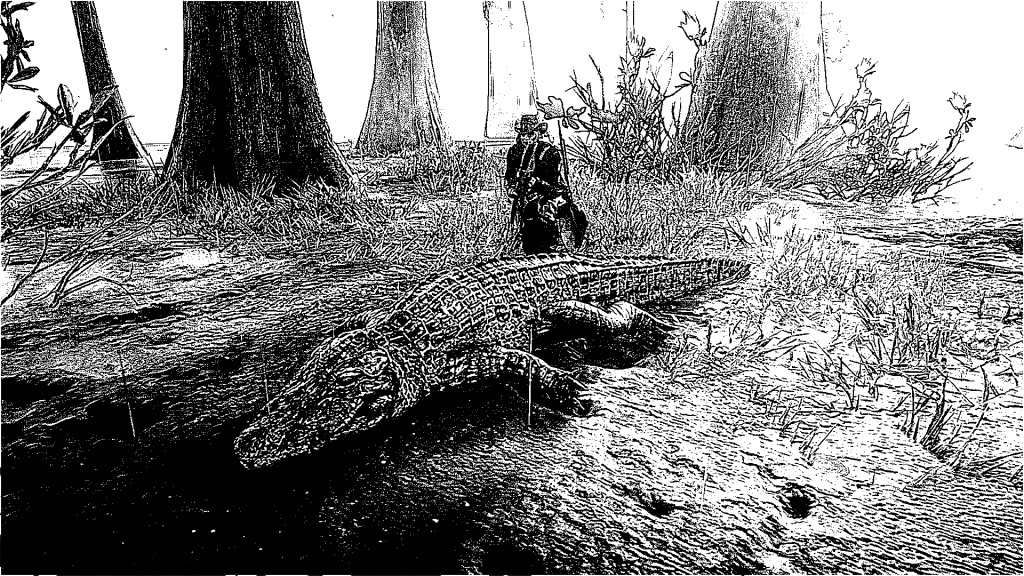
A shootout in Valentine escalated in a way not usually seen. What started as rowdy cowpokes shooting guns at each other quickly turned into a competition over who could throw the most dynamite. Wagons were blown up, windows were shattered, seven people died including two innocent bystanders, and countless more were injured in the fight. Witnesses who escaped the danger zone said the explosions came in quick succession and lit up the night sky. “I couldn’t help but be in awe,” said one witness, “but just as you lost yourself in the brightness you’d be pulled back to reality with the screams.” People fled from main street of Valentine, where much of the fighting took place. Sheriff’s deputies attempted to bring the fight to an end but were forced into defensive positions when arrows with dynamite attached were fired at them. The whole situation was described as chaotic.
Telegrams were sent out to nearby towns and railroad stations, which brought in reinforcements. The lawmen coming from outside of the town were able to get shots off on the cowpokes causing the chaos. Several were killed when the reinforcements arrived, though many escaped. The outlaws road off in different directions, seemingly without a plan. A couple were caught and arrested but most of the outlaws escaped. The townsfolk went to work the next day burying the dead and repairing the broken structures.

Large Steamer Lost Near Lemoyne!
By Sofia Kathleen Fairfax (Lead Correspondent)
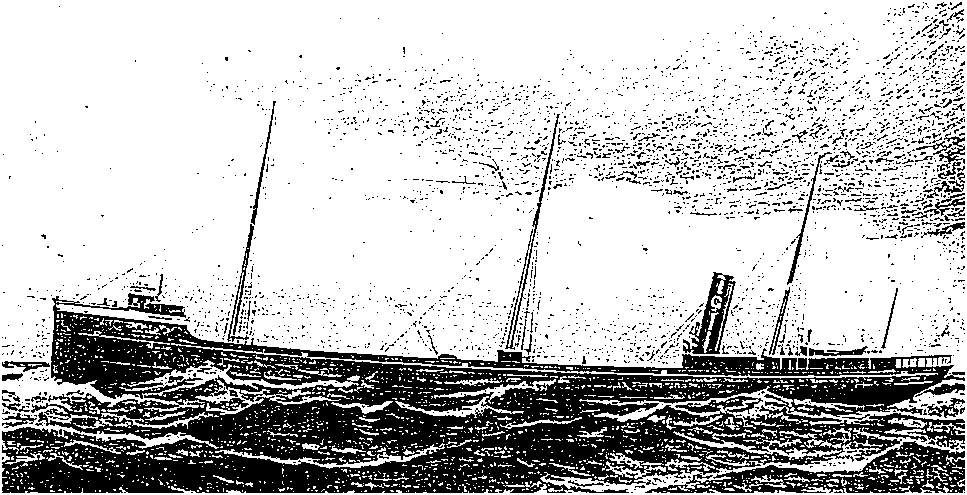
Yesterday morning a young couple near Copperhead Landing were bird watching, when one claimed to see something in the water nearby. It was quickly clear it was a body. The couple ran for help. When local lawmen arrived, dozens of human remains had washed up on the shore. They bore no gunshot wounds or any injuries, but they were gone all the same.
Remarkably, two people were alive, a young girl and an older woman, presumed to be her mother. Their names aren’t known, and their status is still in critical condition.
Where had these people come from? The life jacket on one victim bore a simple name, W.H. Gilcher. The Gilcher is a large freighter known for carrying coal and wheat to various ports across the United States. It’s presumed the ship must have sunk the night before, and rather suddenly at that. No storm was reported at all near Saint-Denis.
The ship’s company, the Cleveland Shipbuilding Company, is less than happy. The Gilcher’s sister ship, the Western Reserve, also sank not too long ago. It resulted in a large court case centered on the steel used in the construction being of substandard quality. If so, the Gilcher’s fate may have been similar, breaking in half without warning.
For now, the families of the 18 recovered crew members mourn. The two survivors weren’t listed on any crew manifest, leading to just more unanswered questions.
Wheeler, Rawson and Co. report an increase in sells of bolas
By Adam Parvey
The bolas, a cord with weighted ends, is a weapon used by bounty hunters all across the Five States. It is a nonlethal means of bringing targets down and keeping them alive. It works by the throwing swinging the weighted ends around and is then thrown at the target. The weights wrap around the target and wrap the target up, making them immobile and easy to hogtie and transport. Bolas are expensive items, which can fortunately be reused. However, retrieving bolas are not always easy. “Sometimes you miss, target gets behind a tree, or just aim poorly,” said a bounty hunter, “and we lose sight of the bolas and sometimes can’t find it.” Bounty hunters also have claimed that bolas somehow disappear if not found fast enough.
These lost bolas need to be replaced and Wheeler, Rawson and Co. are happy to provide replacements. “Bolas are top sellers,” said a representative for the company, “folks usually only buy clothes or a gun once, but bolas they buy over and over.” The company has recently begun offering multiple styles of bolas, some of which can cause a bit more pain than others, but come at a much higher cost. Gunsmiths also offer bolas and have reported that the increase in sells is not just from mail orders but also in store. “Nearly every time a bounty hunter drops off a man across the way, they come into my shop to buy more bolas,” said Valentine gunsmith R.L. Dalton. The increased sells have helped Wheeler, Rawson and Co. to achieve record profits this year and they see no end in sight. “Let’s be honest, there aren’t many good jobs out their for a gunslinger but bounty hunting, so sells likely aren’t going down anytime soon,” said the company representative.

West coast US Army facility transferred to the US Navey
By Frederick Vannesse
Goat Island has been transferred to the United States Navy from the United States Army. The US Army first developed a fort on Goat Island during the Civil War. The Union Army was concerned that the Confederacy would sneak a force between Goat Island and Alcatraz Island to attack the West coast. Such an attack never came but the fort was maintained long after the conclusion of the Civil War and included the development of a torpedo bay in 1891. Officially called Yerba Buena Island until 1895, and referred to as “Isla de Alcatraces” as early as 1775, Goat Island will now be maintained and developed by the US Navy. The US Navy has grand plans for the island, including further development of new technologies and training.

First Canadian Archbishop passes away after years of declining health
By Ivy Seager
Elzéar-Alexandre Taschereau dies in Quebec City this week. Archbishop Taschereau came from a very esteemed family, that included a grandmother who was the First Speaker of the Legislative Assembly of Lower Canada and an older brother who becamse a Puisne Judge of the Supreme Court of Canada. Taschereau himself spent most of his life in Quebec, though did travel throughout Europe, including a period of time spent studying in Rome. He was ordained a priest of the Quebec Archdiocese in 1842. In 1886, Pope Leo XIII made Taschereau Cardinal-Priest of Santa Maria della Vittoria, Rome. He was the first Archbishop to come Canada. Taschereau’s health began to decline in 1892 and he required assistance to complete many of his duties. Archbishop Taschereau is said to have been ready to die and at peace in the months before his passing.
 The Five States Herald