

Mission Statement:
To endeavor to bring to all residents of the Five States the most current and important news from across the entire Five States region. Never yellow, the Five States Herald vows to serve only the people of the Five States, from New Austin to Lemoyne, free of charge now and forever.
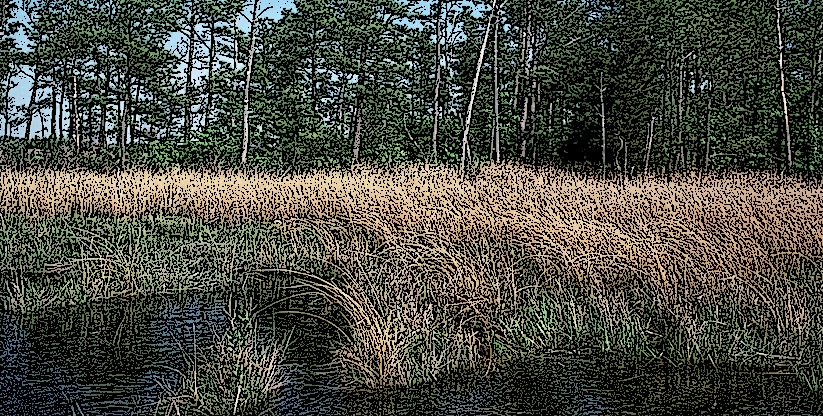
Mysterious Creature Reported in Bayou Nwa!
By Sofia Kathleen Fairfax – Lead Correspondent
Bayou Nwa is not a place for normal folk. The men and women who live there are a hardy bunch, used to isolation, limited resources, and constant danger. At night, the swamps come alive with alligators, big cats, and the dreaded Night Folk. But something else reportedly dwells in the bayou, and it defies description.
Locals have reported occasional sightings of a large creature, almost grasshopper-shaped, nearly the size of a tree. It lies in the tall grass, blending in until disturbed, then it flees.
There is currently no name for this creature. The Long Legs are the closest thing to a name, as noted by an anthropologist in Saint-Denis. The scientific community is skeptical but admits that Bayou Nwa has an unusually large number of creatures; some, like the panther or jaguar, have only been recently discovered. Who is to say some as-of-yet unidentified bug that can grow to an enormous size doesn’t inhabit these lands?
From the few eyewitness accounts, it doesn’t appear to be hostile. Which if true, it would be quite a change of pace compared to the other wildlife. Perhaps in time, more evidence, maybe even a photo, will be produced.

Dreams of leisure dashed by lead at Fort Mercer
By Jose Chavez
A party of eastern investors arrived this week at Fort Mercer, the long abandoned military installation left behind after the Mexican-American War. They were carrying plans and paper dreams of turning the crumbling fort into a tourist destination. Their notion, shared by a growing number of moneyed men, is that as the frontier is slowly tamed and cities grow safer and duller, folk with coin will pay handsomely to experience a controlled taste of the Wild West. Abandoned forts, they believe, might be scrubbed up, staffed, and sold as history made comfortable.
The plan unraveled in familiar fashion. The Del Lobo gang descended on the fort before any survey could be completed, opening fire and driving the investors into hurried retreat. Hired guards held the outlaws at bay long enough for the party to escape intact, but the message was delivered with unmistakable clarity. Similar ventures have been tried before, and all have ended under the same hot sun and gun smoke. Those who survived this attempt left Fort Mercer with fewer illusions, having learned that taming the wilds there may cost far more in blood and silver than any dream of profit can repay.

Gunfire in the night scatters campers from Lake Isabella
By Jane Duran
Campers settled along the icy shores of Lake Isabella were torn from their sleep by shouts and sudden gunfire when a band of outlaws descended upon the remote camp under cover of darkness. The attackers fired wildly, sending sparks off rocks and driving the campers into blind panic as they scrambled for cover. Salvation came unseen at first. The campers said they did not even realize another person had arrived.
“It was chaotic and I was afraid,” said one camper afterward, explaining that it took several moments to realize the outlaws’ attention had shifted away from the camp entirely. The gunfire grew steadier, then thinner, until at last it ceased altogether. When the campers dared look again, the outlaws were gone, and the only figure left standing was a lone stranger, smoke curling from a lowered gun. The gunslinger tipped their hat without a word and rode off into the dark. Shaken and unwilling to test their luck further, the campers broke camp immediately and fled the area before dawn.

Gunfire and bare knuckles on Main Street
By Odell Clifton
Blackwater’s afternoon calm was split wide open when a woman and a lone man came into violent dispute right in the middle of Main Street. Witnesses say the woman raised her pistol first, leveling it squarely at the man, though she never fired. The man answered in panic or fury by firing on her, which sent pedestrians diving for cover.
What followed left onlookers stunned. Though struck by gunfire, the woman advanced anyway, walking straight toward the man with a cold steadiness that unsettled even those used to roughness of this region. She holstered her weapon and turned the matter physical, fists flying as the two traded blows. The struggle spilled toward the sidewalk, the man finally managing to tackle her, the pair rolling and scrambling before clawing back to their feet.
At that point, a bystander rushed in. “It looked like he was going to help the woman,” said one witness, “but she started fighting him as well!” Whatever restraint remained vanished. The woman drew her gun again, shooting one man dead with a single shot to the head before turning and pressing her gun into the other man’s back and firing. She vanished into the streets in the chaos that followed and remains unidentified. Authorities in Blackwater are said to be searching, though many here doubt she intends to be found.

Telegraph lines at Valentine station draw suspicion and scrutiny
By Emery Cosberry
Employees at the Valentine Train Station have come under investigation following mounting allegations from traders who believe the wires themselves have been turned against them. Several merchants claim that telegraph operators are quietly passing along details of trade routes, cargo, timing, and direction, to outlaws lying in wait beyond town limits. As telegrams may only be sent station to station, the accusations carry an unsettling implication: that the corruption is not local and isolated, but shared and relayed along the rail line itself.
According to these claims, information moves from one operator to the next before reaching criminal hands. “Every time I ride by Valentine Train Station, I know I can expect to be attacked,” said one weary trader. “It is as if my location is being told to everyone in the Five States.” While no single message could alert the entire frontier, authorities concede that a chain of cooperating stations, paired with roving bands of outlaws, could explain the troubling precision of recent ambushes.
Officials caution that proof remains difficult to secure, as telegram records reveal little beyond routine traffic, and the men accused continue their duties under watchful eyes. Still, the notion of discouraged clerks selling secrets from behind brass keys and ticking machines has unsettled traders across New Hanover. Should the allegations prove true, the telegraph, once hailed as the spine of modern order, may instead be remembered as the silent accomplice to a widening campaign of theft and bloodshed.

Steel and spectacle on the Saint Denis docks
By Emeline Vickroy
Dockworkers along the Saint Denis waterfront were given an unexpected show when a passing cowpoke paused amid the crates and coil-ropes to demonstrate an array of gun-twirling tricks, spinning iron with a speed and confidence that drew applause from stevedores and sailors alike. The mood was light, even admiring, until one onlooker, unimpressed and sour-faced, pushed through the gathering and lunged at the performer with a knife, turning amusement into alarm in the blink of an eye.
The cowpoke holstered his revolver and met the attack with his fists, proving far more capable in close quarters than the knifeman anticipated. Blow after blow drove the attacker backward until, in desperation, he reached his rifle, which was carried over his shoulder. That proved the last mistake. The cowpoke knocked the weapon aside and unleashed a furious combination of punches, finishing with a brutal overhead strike and then grabbing him and slamming him hard against a wooden post. The attacker collapsed unconscious to the planks, while the victor stepped away without ceremony, leaving dockworkers wide-eyed and newly convinced that skill with a gun often comes paired with something far more dangerous.
An old trend returns, much to the annoyance of some
By Adam Parvey
With little fresh diversion to stir the blood across the Five States, cowpokes and camp-dwellers alike have fallen back into an old and weary habit: stopping one another to ask after the merit of coats, hats, boots, and buckles. The practice has spread without warning, cropping up at hitching posts, saloons, and trail junctions, and always follows the same course: initial politeness, reluctant answers, and eventual irritation. “I’m tired of being asked to judge another’s outfit,” said one trail-worn rider, shaking his head. “A man ought to know well enough what he’s wearing without polling the countryside.”
Others were less restrained. “Yes, you look plain as sackcloth and twice as forgettable, but who cares?” snapped another cowpoke, speaking between pulls of coffee. Many recall that this same talk of fashion has risen and fallen before, half a dozen times by some counts, and each time leaves behind only frayed tempers and wounded pride. Though many say the trend is not harmful and builds community in a society that has been forgotten. Still, hope persists that this revival will meet a quicker end, and that when it does, it may stay buried at last, along with other idle habits better left in the dust.
 The Five States Herald