

Mission Statement:
To endeavor to bring to all residents of the Five States the most current and important news from across the entire Five States region. Never yellow, the Five States Herald vows to serve only the people of the Five States, from New Austin to Lemoyne, free of charge now and forever.
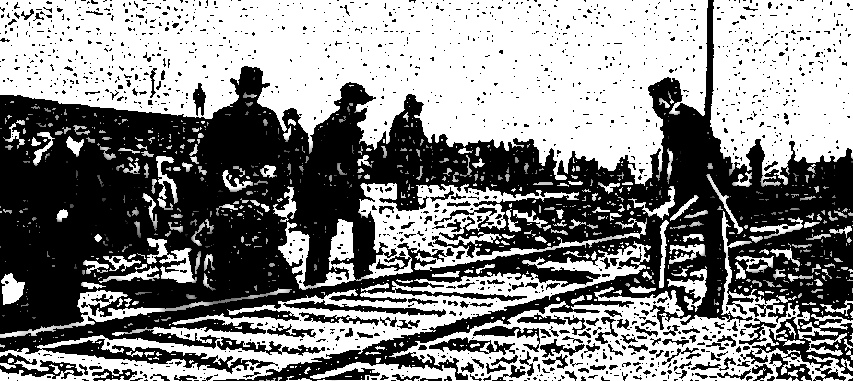
So Long, It’s Been Good to Know Ya: Workers Leave Five States!
By Sofia Kathleen Fairfax – Lead Correspondent
The great beast of America, the economy, always ebbs and flows. One year it will tower high over all nations, sometimes it will crash like a fading wave. We are currently in the latter, and many workers in the Five States, well, they can’t keep going as they do.
Numerous railroad workers, shop workers, and farmers have been leaving. Some can’t support themselves anymore, others don’t think their industry can survive. They have packed their bags, gotten onto carriages, wagons, or trains, and headed off. Some are headed east to major cities, others further out west, maybe to strike it rich. Each worker, each family, is its own story.
One worker, who talked to us anonymously, lamented that he is depressed about losing his job and leaving friends behind. But also, he admitted he had long since grown tired and numb of his job and hated his bosses. He thinks, perhaps, that it’s for the best and that, from this loss, something better can grow. I only hope that all those who are moving on can one day gain this man’s wisdom. This dusty old dust is a getting my home, and I’ve got to be drifting along.

Deception and gunfire in Tumbleweed’s dusty roads
By Jose Chavez
Tumbleweed, that stubborn outpost of law in the harsh reaches of New Austin, was set upon this week by a most brazen act of deception. A lone woman arrived by wagon and halted near the town jail, claiming she bore several bounties for processing. Deputies, accustomed to such deliveries in a place where justice is swift and frequent, approached without suspicion. Their trust proved costly. When the wagon doors were thrown open, not bound prisoners but nearly a dozen armed men emerged, guns already drawn. In the first volley, a deputy was struck in the chest and killed where he stood, his badge offering no shield against the sudden violence.
What followed was as swift as it was decisive. Tumbleweed, known for its heavy law presence, answered in force. Lawmen converged from all sides, and within moments the attackers were cut down under a storm of return fire. The woman, left alone amid the fallen, raised her hands and surrendered without further struggle. In custody, she offered a curious explanation, that her actions were driven not by revenge but by tales of hidden treasure guarded by Tumbleweed deputies. Authorities dismissed the claim, pointing to the town’s state of disrepair. “If we had some hidden treasure, we’d have long sold it to help these folks,” said one deputy.

Gold for folly leaves man near death in the Grizzlies
By Jane Duran
A man was found barely clinging to life in the frozen reaches of Ambarino this week, his body spared from the worst of the cold by thick winter clothing, yet ravaged from within by violent illness. Those who discovered him reported he had been grievously sick, his garments stained and his strength nearly spent. After several days under watch and care, the man confessed to a reckless act: the consumption of five pieces of raw meat, taken in haste and without fire. Such eating is known among trappers to bring on severe stomach afflictions, often accompanied by fever, retching, and weakness that can leave a body as helpless as if struck by the elements themselves.
The man claims he was offered gold by a stranger along a trail in exchange for eating the meat, an offer he accepted without thought for consequence. “I had no time to cook it, so I ate it as it was,” he reportedly said, adding with bitter clarity, “I got the gold but I regretted it.” Frontier remedies, strong spirits, bitter tonics, and enforced rest, have thus far kept him from the grave, though his recovery is expected to be long and uncertain.

Raid on hidden still turns riotous in West Elizabeth
By Odell Clifton
What was meant to be a quiet and orderly shutdown of an illicit moonshine operation in West Elizabeth turned instead into a spirited brawl. Acting under cover of darkness, agents descended upon the hidden establishment and made their way below, expecting to find nothing more than copper stills and contraband spirits. Instead, they stumbled into a full gathering already well underway: patrons deep in their cups, boots stomping in time, and a lively band filling the air with music. The scene, described by one shaken official as “more festival than felony,” came to an abrupt halt as agents demanded the music cease and revelers line up for questioning.
The order was not received kindly. A guitar-playing cowpoke, flushed with drink and defiance, reportedly cried out for “just three more seconds!” before being roughly pressed against a wall by an agent. That moment proved the spark to powder, as tempers flared and fists soon followed. What began as enforcement gave way to a full barroom brawl, forcing agents into a hasty retreat for their own safety while managing to seize a handful of fleeing participants. Whether the true operators of the still were among those taken remains uncertain.
Lawmen warn of grim discoveries along roads and wilds
By Frederick Vannesse
Reports have begun to circulate in uneasy whispers, now confirmed in part by scattered law offices across the Five States, of a most disturbing pattern: piles of burned bodies discovered in lonely stretches of land. These sites, some hidden deep within the wilderness and others found alarmingly close to well-traveled roads, bear no clear mark of identity. No names, no possessions, no distinguishing features remain to tell who these unfortunate souls once were. Lawmen admit that while no firm link has yet been proven between the scattered discoveries, the similarities in condition and circumstance suggest a troubling common hand may be at work.
Officials have declined to state how many such sites have been uncovered, a silence that has done little to calm public nerves. Travelers are now urged to keep a sharp watch even on familiar routes, as the danger appears not confined to any one territory or trail. Whether this is the work of a single ruthless party or several acting under some shared design remains unknown. Until clearer answers emerge, the warning stands plain: the open road, once a symbol of freedom, may now carry a shadow that follows close behind.

Gunfire and rumor at Keane’s saloon
By Donna Deshner
Valentine saw its peace broken this week when Keane’s Saloon was riddled with gunfire by a gang numbering anywhere from six to a dozen men, depending on which shaken patron you ask. The attackers, described as rough riders with no uniform mark of allegiance, were heard shouting for the whereabouts of the elusive bounty hunter Tom Lockburn, a name that drew more fear than recognition among those gathered. Yet before the chaos could claim more than shattered glass and overturned tables, a woman, who remains unidentified, stepped forward in a fury and answered the call with a level action rifle. Witnesses recount with equal parts awe and dread how she dispatched the assailants with swift precision, leaving the saloon thick with smoke and silence.
Deputies arrived only after the last shot had rung out, finding the scene already decided. The women said she did not know of Tom Lockburn or the men’s motivation, only that, “my hair was singed by a bullet and it set me off something fierce.” Nobody, lawman or civilian alike, could offer a clear account of Tom Lockburn’s presence, or absence, during the ordeal. Matters deepened further when federal investigators rode into Valentine the following day, asking pointed questions about Lockburn’s movements and associations. Their inquiries were met with shrugs, silence, or suspicion, and as of this printing, the man himself remains unaccounted for, his name once again spoken louder than his shadow.

Street assaults in Saint Denis masked as ‘scientific study’
By Aloysius Levron
Authorities in Saint Denis have taken into custody a cowpoke whose so-called “experiment in the name of science” has left a troubling trail of battered citizens across the city’s busy streets. According to officials, the suspect claimed to be studying the limits of human endurance, not through exposure to the blistering heat of New Austin nor the biting cold of Ambarino, but by striking unsuspecting individuals into unconsciousness. Witnesses report the cowpoke would approach at random, deliver a sudden and forceful blow, and then linger nearby to observe the time it took for their victims to recover their senses. The suspect’s reasoning, as later recounted, was that Saint Denis offered “the largest sample in one place,” making it ideal for repeated trials.
Despite the city’s considerable police presence, the assailant managed to evade notice for a time through careful movement and a calculated avoidance of patrol routes. Their efforts came to an end, however, when officers apprehended them and discovered on their person a detailed ledger cataloging each attack. The document reportedly includes names or descriptions of victims, the method of assault, and precise recovery intervals, evidence so thorough that officials believe the case will proceed with little difficulty. Public concern now turns toward the well-being of those affected, and whether any lasting harm may arise from a scheme that cloaked brutality in the language of inquiry.
Tickets offered for the Paris Olympic spectacle
By Adam Parvey
Tickets for the forthcoming Olympic Games in Paris have gone on sale this week, marking another bold step in the revival of an ancient tradition long thought buried beneath the dust of antiquity. The Olympic contests, first known in the annals of old Greece, were restored to the modern world just two years past, when the 1896 Games drew over two hundred athletes into spirited competition. Among them, the United States secured a place in history as James Connolly leapt his way into record as the first Olympic champion in over fifteen centuries, claiming victory in the triple jump and stirring pride across the young nation.
Organizers now look ahead to Paris, where the second modern Olympiad shall unfold as part of the grand World’s Fair, promising both spectacle and contest in equal measure. Plans are set to mirror the nineteen sporting events of the previous Games, while ambitions run higher still, with hopes of surpassing the number of participating athletes. Of particular note is the intention to include female competitors, an unprecedented development that signals a widening of the Olympic field. Whether Paris shall equal or exceed the triumphs of Athens remains to be seen, but anticipation travels swiftly across continents, carried on the same winds that once bore the ancient games into legend.
 The Five States Herald