

Mission Statement:
To endeavor to bring to all residents of the Five States the most current and important news from across the entire Five States region. Never yellow, the Five States Herald vows to serve only the people of the Five States, from New Austin to Lemoyne, free of charge now and forever.
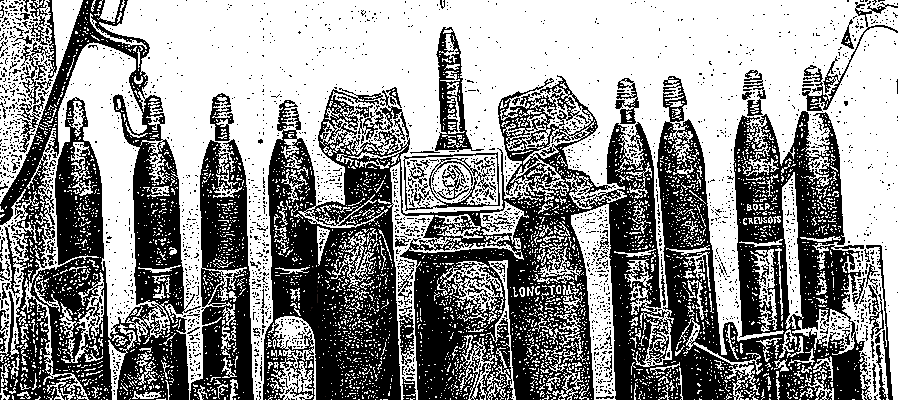
Portable Artillery Shell Bomb?
By Sofia Kathleen Fairfax – Lead Correspondent
Explosives on the battlefield are a fairly new invention, far as the history of war goes anyway. Now the use of these explosives, has been very consistent, used primarily in firearms and artillery. Whether it’s the cannons that brought down Constantinople or the rockets red glare of 1812, not a lot has changed fundamentally. Grenades and dynamite have been more handheld, but it’s not quite the same. Well, some military thinkers are considering mixing the two.
A recent British military test has been reported, and it involved what can only be described as a portable knapsack bomb. An artillery shell was modified to carry a long fuse, and made small enough to fit into a knapsack. The user then hit the fuse, put the sack down, and watched it detonate with the force of a normal artillery shell.
Witnesses were impressed, especially with how fast the soldier was despite the weight. There were concerns about safety and the fuse length, but first impressions were positive. The soldiers are already giving it a nickname, the Blighter Bomb.
American diplomats are always asking whether they can be given a live-fire exercise. One anonymous soldier said he cannot wait to get his hands on the device, which, of course, will probably be given a more American name, like hell bomb or something.

Bounty hunter seized in Tumbleweed amid questions of unlawful contracts
By Jose Chavez
Authorities in Tumbleweed have detained a bounty hunter whose latest claim has raised troubling questions about the legitimacy of private justice in New Austin. The man, whose name has not been released, presented what he insisted was a lawful bounty, complete with poster, after delivering a dead suspect to town. However, upon review by officials under Sheriff Sam Freeman, no corresponding record of the bounty could be found in any territorial registry. The killing, absent legal standing, has thus been treated not as bounty work, but as an unlawful act. Witnesses report the hunter remained steadfast in his claim, insisting he had merely fulfilled the terms set before him.
Of particular concern is the name the accused offered in his defense: James Langton, a former bounty hunter who has since turned outlaw. The suspect alleges that Langton himself issued the contract, suggesting the existence of a shadow network wherein private individuals post bounties beyond the reach of the law. Federal investigators have since assumed custody of the accused, indicating that this matter may extend far beyond a single incident and tie into the ongoing investigation into private bounties. Though officials have not confirmed Langton’s involvement, speculation persists that he may play a central role in an emerging and dangerous trade, one that blurs the line between justice and sanctioned killing.

Gold promise on Mount Hagen draws blood and vanishing gunmen
By Caylen V. Hornby
An ambitious and ill-considered challenge set forth by a wealthy benefactor has stirred chaos upon the icy slopes of Mount Hagen. Word spread swiftly among enterprising cowpokes that gold nuggets would be awarded to any soul bold enough to make the ascent, a prize that proved sufficient to draw climbers into the treacherous heights of Ambarino. Yet what began as a test of endurance soon turned into a contest of survival. A gang of armed outlaws, their identities unknown, seized advantageous positions along the mountain’s ridges and passes, opening fire on those attempting the climb. Several would-be claimants were forced to retreat under the threat of rifle shot, their ambitions cut short by lead rather than cold.
In response, Ambarino Rangers organized an effort to reclaim the mountain and drive off the assailants, though nature itself intervened before any decisive engagement could occur. A sudden and violent storm swept across the peak, reducing visibility and rendering movement nearly impossible. By the time the weather relented, the outlaws had vanished entirely, leaving no trace beyond scattered shell casings and abandoned vantage points. Whether their aim was to disrupt the contest or simply to exploit it for cruel sport remains uncertain. What is clear is that Mount Hagen, already perilous by its nature, has become the stage for a more deliberate and human danger.

Hunter survives deadly fall and falling beast near Wallace Station
By Odell Clifton
A grave incident along the bridge spanning Little Creek River near Wallace Station has left one hunter injured but fortunate to have escaped with his life. A fisherman working the waters below reported seeing the man positioned atop the rail crossing, taking aim with a scoped rifle at a large grizzly in the nearby timber. “The bear seemed to notice and ran into the woods, then onto the tracks,” the fisherman stated. “It stormed across the tracks and the hunter fell off.” The drop carried the man from the narrow trestle to the ground beneath, where the soil, softened by recent moisture, absorbed enough of the fall to spare his life, though not without consequence. The hunter suffered a broken arm upon impact, leaving him vulnerable as the wounded animal advanced above.
What followed was a moment of desperate resolve. From his position below the bridge, the hunter managed to raise his rifle and fire a final shot as the grizzly loomed overhead. The shot proved fatal. The animal’s immense body collapsed and plunged from the crossing, missing the injured man by a margin the witness describe as alarmingly slight. Had it struck him, death would have been certain. The hunter was later assisted from the scene, his arm crudely bound, and is expected to recover. The episode serves as a stark reminder of the hazards posed not only by dangerous game, but by ill-chosen vantage points along the region’s rail structures.

A grim warning raised in Van Horn as progress meets resistance
By Van R. Seldon
Van Horn Trading Post has long held its reputation as a place that answers to no badge and bows to no outside hand, a town where disputes are settled by those who live them and not by distant offices. That reputation took on a darker edge this week when a government agent, tasked with overseeing the replacement of a post intended to carry electrical power into the settlement, was discovered dead under circumstances as stark as they were deliberate. The man’s body was found impaled upon the very post he had come to install, driven clean through him and set upright like some grim marker along the roadside. No witnesses have come forward, and no sign of struggle or perpetrator has been officially recorded.
Those who call Van Horn home have offered nothing in the way of answers, meeting inquiry with shrugs, silence, or a practiced ignorance that speaks louder than words. It is a town accustomed to handling its own affairs, its streets lined with armed citizens who neither ask nor grant permission when trouble comes calling. Officials beyond Roanoke Ridge have stated plainly that the work will continue, though now under the watch of armed guards, signaling that progress will not be so easily turned aside. Whether this latest act serves as a final warning or the beginning of further bloodshed remains to be seen, but one truth stands firm: Van Horn has made its position known without saying a single word.

Bounty hunter wanted for murder
By Aloysius Levron
Three men were discovered lifeless in an upper room near the docks this week, their bodies arranged in such a manner as to suggest violence both sudden and decisive. Dozens in the surrounding streets report the unmistakable crack of gunfire, yet not a single soul has come forward claiming to have witnessed the act itself. Officers under the direction of Chief Benjamin Lambert arrived promptly, securing the premises and turning away all but official personnel. The deceased, each found with a pistol still clasped in stiffened fingers, bore wounds consistent with a close-quarters exchange, though authorities have declined to offer any formal interpretation of the scene.
What the police will not say, the streets have already begun to whisper. Multiple accounts place the figure of Tom Lockburn departing the vicinity not long after the reports of gunfire. The man, known in equal measure for his quiet efficiency and his unsettling habit of appearing where trouble has already ripened, was described as calm, unhurried, and bearing no visible injury. Yet a source who spoke privately to this paper, requesting anonymity for fear of reprisal, offers a version of events that complicates the matter further. “There weren’t no fourth man,” the witness stated. “I went in after the noise stopped. Just them three, laid out and bleeding, guns still in hand. No sign anyone else had been there at all.”
Such testimony raises more questions than it answers. If the men felled one another, why? And if Lockburn was involved, were these men outlaws or victims of more private bounties? Until the police elect to speak plainly, the mystery will likely only grow.
How does Madam Nazar get around the Five States?
By Frederick Vannesse
Across the breadth of the Five States, from the frostbitten reaches of Ambarino to the humid lowlands of Lemoyne, there persists a singular curiosity: how does Madam Nazar come and go so completely unseen? The woman, known widely for her trade in curious artifacts, trinkets of both common make and rare provenance, has made a habit of appearing in the most unlikely of places. One day she is said to be stationed beside a lonely trail, the next vanished entirely, only to be found again in some distant hollow or roadside clearing. Those who seek her must often wander long and far, guided more by rumor than certainty. Yet what confounds even the most seasoned traveler is not her movement alone, but the absence of any visible means for it. Her wagon stands wherever she settles, stout and weather-worn, but never is there a horse tethered nearby, nor tracks left plainly enough to satisfy suspicion.
Theories, as one might expect, have begun to circulate with increasing enthusiasm. Some insist her trade is bound up in forces not easily explained, whispering of charms, spirits, and old-world conjurings that allow her to step between places as one might cross a room. Others, more grounded in their thinking, argue that the mystery is merely one of clever habit. “Likely she uses a horse like everyone else,” remarked one cowpoke in casual conversation, “only she lets it roam free, and calls it when she needs it. The trick ain’t magic, it’s how she whistles it back from wherever it’s gone.” Whether such explanations satisfy the truth or merely dress it in plainer clothes remains uncertain.
 The Five States Herald